How Do Trigger Work
Triggers consist of three parts:
Activators: define “when the question is asked?”
Conditions: answer the question “when should this trigger fire?”
Actions: answer the question “what should happen when it does?”
Triggers are evaluated in alphabetical order by name. In some situations, triggers might be the wrong choice, see Limitations for more information.
Activators
Triggers support two types of activators:
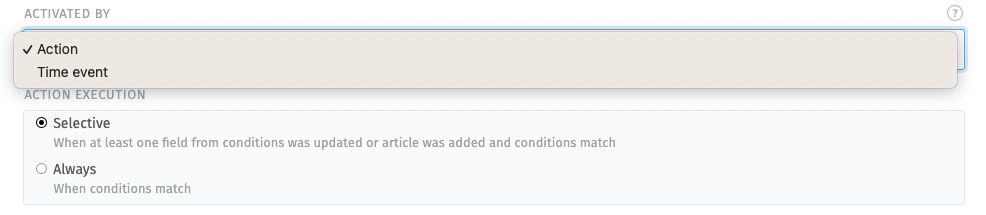
Action
An action based trigger always requires a ticket update to run. This can be an update by an agent or even internal system updates like updated SLA times. See the explanation below for more details.
- Selective
Checks if any attribute from the condition was updated. If yes, the trigger runs. If the attributes from the condition weren’t touched, the trigger doesn’t run.
Example: A trigger with a condition for priority 1 low will run if the ticket was changed to 1 low.
- Always
Checks if the current state of the ticket matches the condition. This means: the trigger always runs when the ticket is updated, no matter what was changed. This can lead to executing such a trigger more often.
Example: A trigger with a condition for priority 1 low will run if the ticket was moved to another group while priority was set 1 low.
Hint
If in doubt, use Selective. The Always action activator can lead to unexpected behavior, e.g. the trigger runs after internal system changes of the ticket, which aren’t visible in the ticket history.
Time Event
The execution is triggered at a specific time when a certain event is reached, e.g. ticket pending time.
This activator simply checks if conditions match. This is the same behavior as action-based activator’s “always” mode.
When creating a trigger, choose activator here:
Conditions
When creating a trigger, define your conditions here:
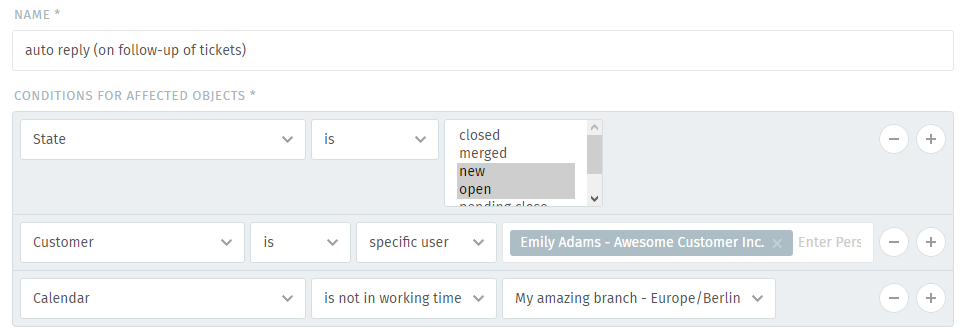
Trigger conditions must match as configured for the trigger to fire.
Hint
👋 Looking for more depth explanation on conditions? 🤓
Many condition settings in Zammad, no matter if in ticket scope or not, re-appear in several places of Zammad. For this reason we created a dedicated documentation section to avoid duplicate content.
Have a look at Object Conditions to learn even more! 🎉
Actions
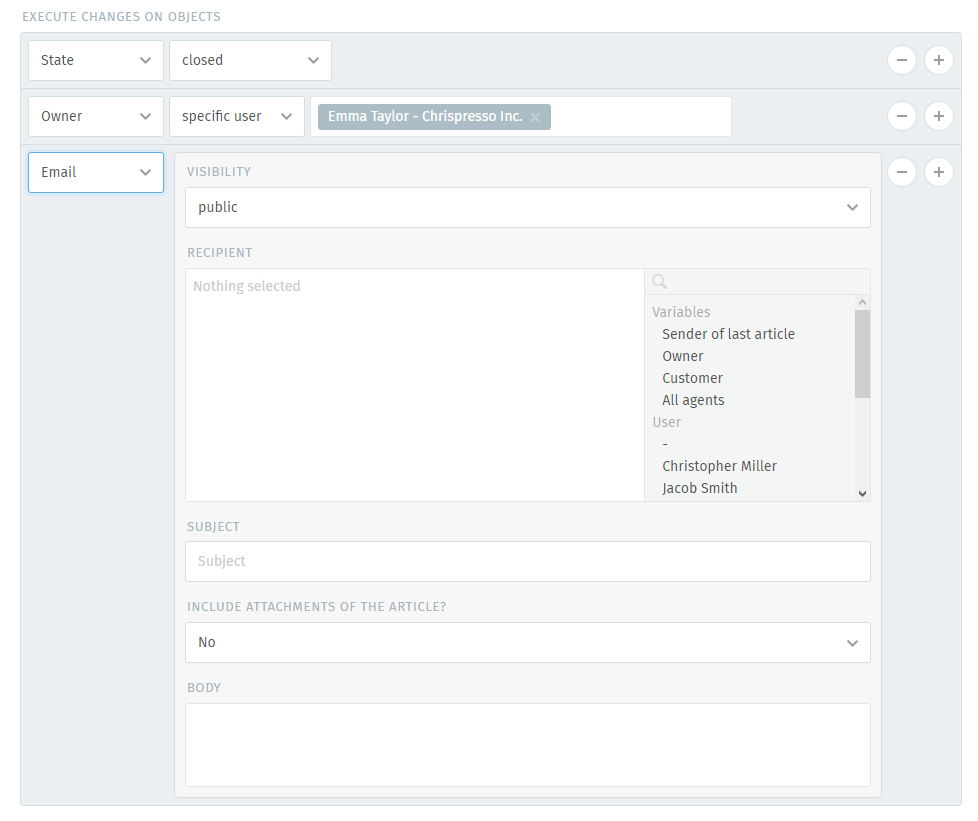
When creating a trigger, define your changes here:
Hint
Certain actions (such as email, SMS and notes) support Variables, which can be used to build highly-customized message templates.
A trigger can do the following things once its conditions have been met:
- Modify the ticket
Examples: escalate its priority, close it, reassign it, rename it, add tags, subscribe and unsubscribe specific/all users, etc.
Date & time attributes (like Pending till) can be specified in absolute or relative terms.
You can also combine static text with placeholders for text fields. Remember that the placeholders’ values have to be known during trigger runtime. Learn more about Variables.
- Send an email or SMS
Either to the customer, the agent who owns the ticket, or every agent in the system.
Sending emails allows you to include the attachments of the triggering article if required.
In order to send emails with triggers, you need to configure an email address for the group, the trigger is working in. If you don’t, Zammad will skip the trigger completely.
- Fire a webhook
Connect Zammad to another web service or application to give it live updates about new tickets.
- Add internal or public notes to the ticket
This allows you to help your agents with specific information if needed. (e.g. automated changes a trigger applied to the ticket)
Localization of Execution Changes
The system locale and timezone predefines a default format of date and timestamp replacement variables. These settings are customizable for triggers.

Best practice is to create single separated localized triggers for each language/timezone and execute them based on user or organization attributes.
The format and timezone of date and timestamp replacement variables is customizable by the use of the dt() method. Further on the t() method can be used to translated string replacement variables according to the selected locale language.
For usage of the t() and dt() method, please follow the instructions in the variables section.